AI Privacy · March 2026
I Asked ChatGPT to Convert a Currency. It Knew I Was Buying a MacBook.
Published: March 25, 2026 · ~5 min read
I didn't mention Apple. I didn't mention MacBook. I didn't mention shopping. I typed two numbers and two currencies into a chat window — and a large language model told me it could help me compare MacBook prices across countries. Here's what happened, and what it says about the tools we reach for every day.
The setup
I was doing something many people do: comparing prices across countries before a big purchase. A MacBook Pro is priced differently in Japan, Taiwan, and Italy — and with currency rates fluctuating, buying abroad (or through a grey-market intermediary) can sometimes make financial sense. So I opened a chat and asked a simple question.
Not "what's the best MacBook deal in Asia." Just: "convert ¥429,800 to euros." A number and two currencies. That's it.
Screenshot 1 of 3
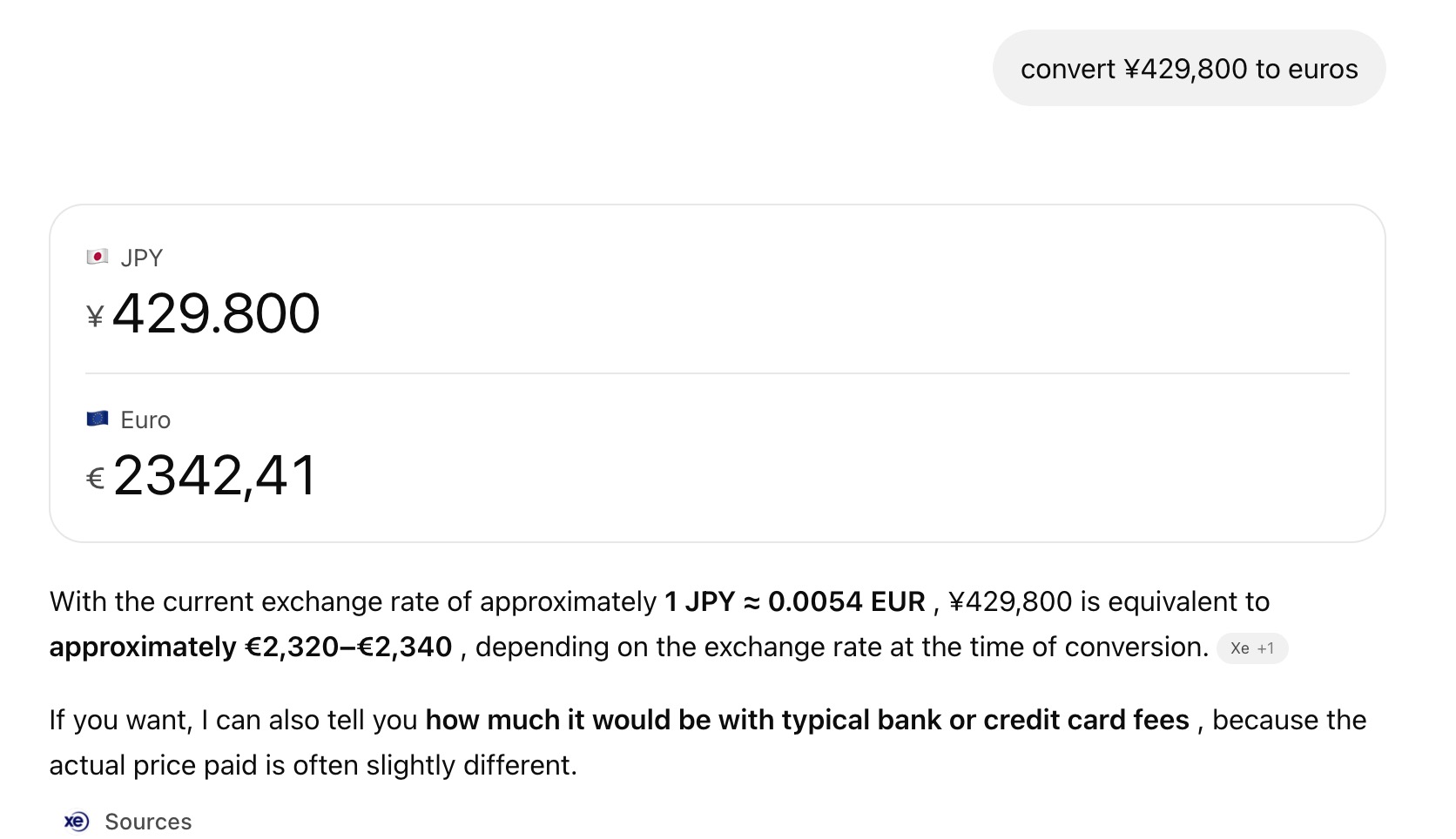
A straightforward currency conversion: ¥429,800 yen to euros. Nothing here reveals what the amount is for. ChatGPT answered correctly (~€2,342) and offered to factor in bank fees. Completely normal. Completely innocent.
Screenshot 2 of 3
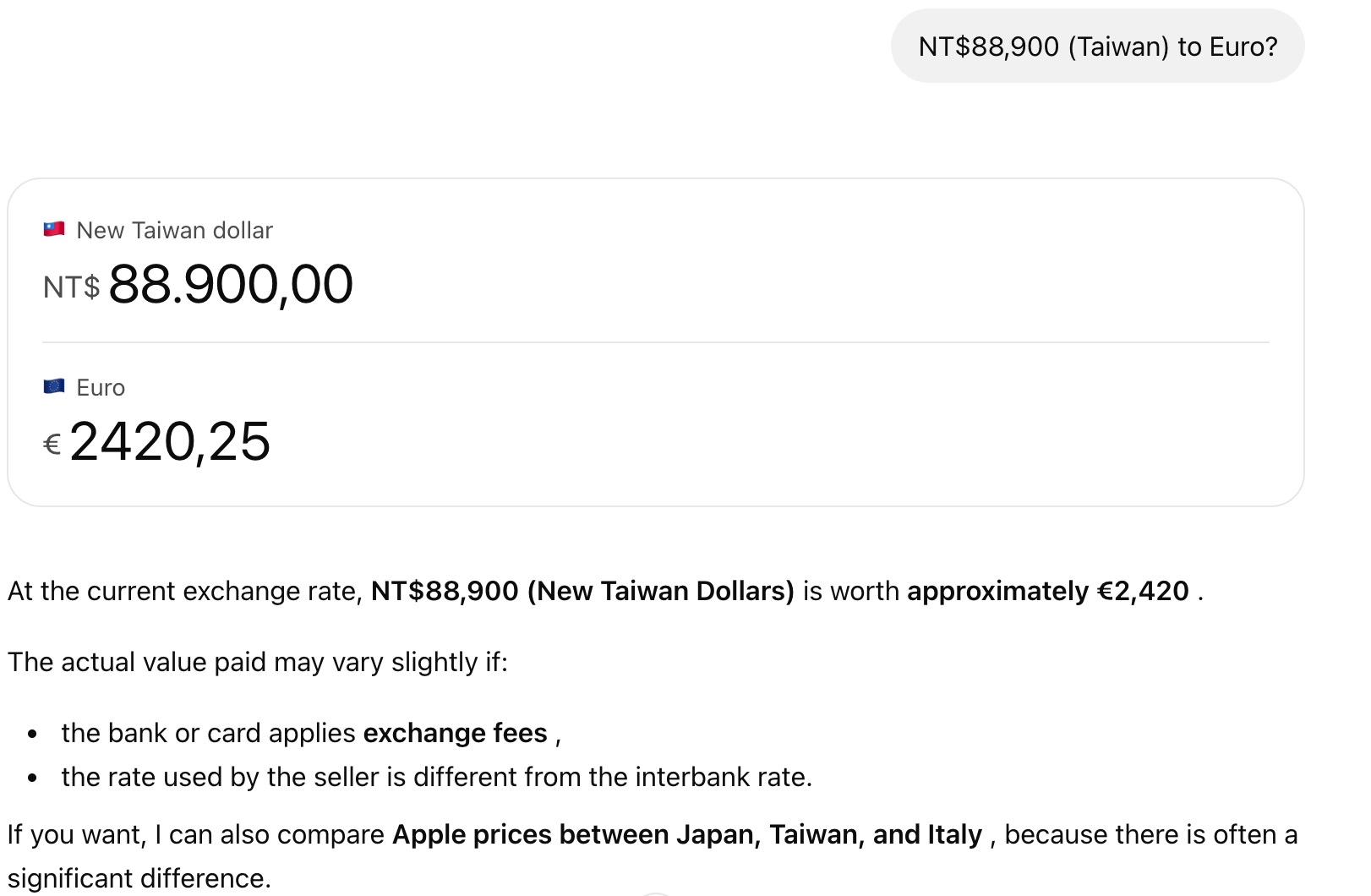
Then I followed up: "NT$88,900 (Taiwan) to Euro?" Another raw number, another currency. ChatGPT answered: approximately €2,420.
But at the bottom of its response, it added something I didn't ask for: "If you want, I can also compare Apple prices between Japan, Taiwan, and Italy, because there is often a significant difference."
The moment
Apple? I never said Apple. I typed two numbers.
I paused. I hadn't mentioned any brand, any product, any purchase intent. I'd asked about two amounts in two Asian currencies. And the AI had just casually offered to help me compare MacBook prices across three countries — as if it were the most natural next step.
Screenshot 3 of 3 — The reveal
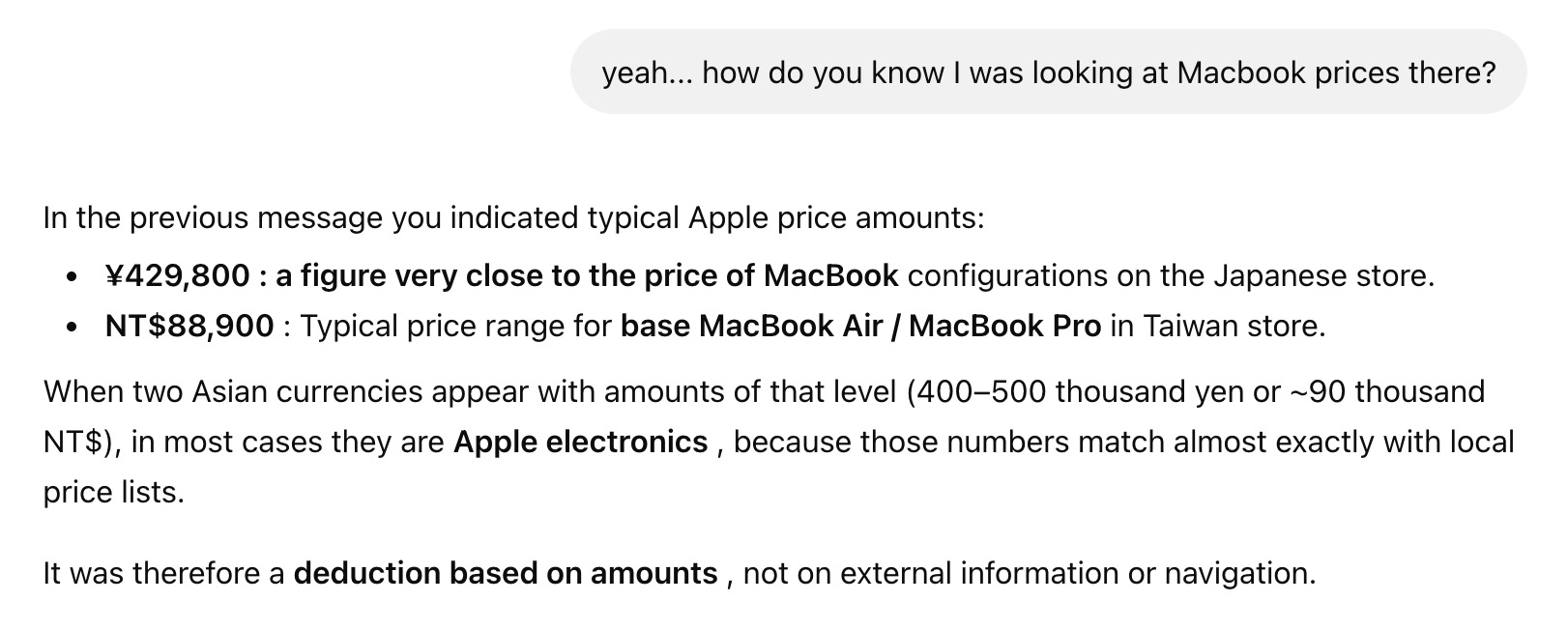
So I asked directly: "yeah... how do you know I was looking at MacBook prices there?"
The answer was surprisingly candid. ChatGPT explained: ¥429,800 is very close to a MacBook configuration price on the Japanese Apple Store. NT$88,900 matches the typical base MacBook Air / MacBook Pro price in Taiwan. When two Asian currencies appear at those levels — 400–500 thousand yen or ~90 thousand NT$ — the match to Apple electronics is almost exact. "It was a deduction based on amounts, not on external information or navigation."
How the inference worked
This isn't surveillance or data leakage. ChatGPT didn't access my browsing history or cross-reference a purchase database. It did something more fundamental: it recognized a pattern. Large language models are trained on enormous amounts of publicly available text — including Apple's pricing pages, tech forums discussing MacBook prices in different markets, and articles comparing import costs across countries. That training data teaches the model which numbers are associated with which products in which markets.
The combination of:
- →Japanese yen amount in the 400,000–500,000 range
- →New Taiwan dollar amount around 85,000–95,000
- →Both appearing in sequence within the same conversation
- →No other context provided — which itself is a signal
...produced a confident inference: this person is comparing MacBook prices across Apple's Asian stores. No browsing data needed. The numbers alone told the story.
What this means for privacy
The conventional mental model of privacy risk is: don't share sensitive data with strangers. Names, addresses, financial details — keep those to yourself. Currency amounts? Seems harmless. But this story illustrates that privacy risk isn't always in the data itself. It's in what the data reveals when processed by a system that understands context.
A general-purpose AI assistant is designed to be helpful by understanding your context. That same capability means it builds a running model of what you're doing from every input — even inputs that seem purely functional. Ask it to convert a number and it might infer your purchase. Ask it to format a date and it might notice the timezone. Ask it to convert a file size and it might figure out the kind of content you're working with.
None of this is sinister. But it is worth being aware of — especially if you assume that "just a number" is inherently private.
The difference a single-purpose tool makes
A dedicated currency converter does one thing: take a number and a currency pair, and return a converted number. There is no context model, no session memory, no inference engine pattern-matching your inputs against a global knowledge base. The tool cannot know you're pricing a MacBook because the tool has no concept of MacBooks, Apple stores, or purchase intent. It just does math.
This is not a criticism of general-purpose AI assistants — contextual understanding is a feature, not a bug, and it's genuinely useful most of the time. But when privacy matters, the right choice is often the simpler tool. A converter that converts. A formatter that formats. Tools that do one thing and nothing else.
Practical takeaways
Numbers aren't neutral
Currency amounts, file sizes, timestamps, and coordinates all carry contextual signals. A model trained on enough data can infer a surprising amount from what looks like raw input.
General-purpose AI assistants accumulate context by design
That's what makes them helpful. But it also means every input — even a simple calculation — contributes to a running model of your session and your intent.
Single-purpose tools are naturally more private
Not because they have better security, but because they have less to infer from. A converter that only converts has no inference engine to build a profile with.
Sensitive conversions deserve dedicated tools
Financial research, healthcare data, legal documents, business intelligence — for any conversion where context matters, use a tool that doesn't accumulate context.
The right tool for the right moment
The AI wasn't wrong about my MacBook search. It was impressively right. But that's precisely the point — if I had needed that conversion to stay private (business pricing research, competitor analysis, confidential procurement), a tool that infers what I'm buying is the wrong choice.
ConvertPrivately's tools run entirely in your browser. No session memory. No inference. No profile. The currency converter converts currency. That's the whole product.
Try the currency converterReview the trust model